
Atoms and Elements
There are over 100 different elements which are made up of atoms. Oxygen, for example, is an element which is made up of 2 oxygen atoms. Compounds on the other hand, are molecules made up of different types of atoms. Elements can be divided into metal and non-metals. Chemical symbols and formulas are used to represent elements and compounds. All of the discovered elements can be located in the wonderful periodic table. This table is organised to show the mass of an element, the amount of subatomic particles, the reactivity and much more. Below is the godly table itself and it even tells you what the different groups mean and what the numbers mean. You lucky lot...

Believe it or not, you, the air, the ground, the Earth and everything else are all made of tiny particles, invisible to the naked eye. These are the atoms. Before you get into any confusion, atoms are not the same as cells. The world's population of humans would fit into a mere box just a thousandth of a millimetre across, if we were all the size of an atom!
Atoms have a nucleus and various shells and all of those properties determine what type of atom it is. The proton and neutron can be found in the nucleus while the electons can be located in the inner or outer shells. The electrons will be found in pairs or on their own. Imagine a bus, you see a seat on its own and a spare seat next to a stranger. You would sit on your own right? Likewise for electrons, just without the thinking. Protons and neutrons have a mass of one but the electron is equivalent to zero. Meanwhile, the electon has a negative charge and the proton has a positive charge. The neutron is unsurprisingly, neutral!
How large do you think atoms are? Well, in school or tests, if you have to draw a diagram, we have to be realistic. Atoms are blind to the naked eye, but to draw particle diagrams to represent them, we would have to draw this. Below are the small balls we draw in 2d. There are only solids and liquids because the only two elements at room temperature are Mercury and Bromine.
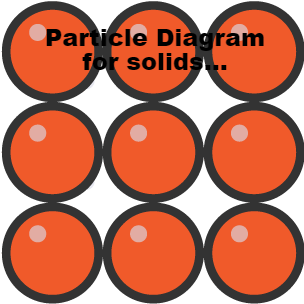
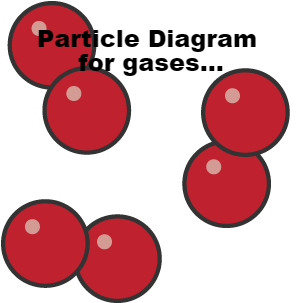
Periodic Table
In the periodic table, there are many things to learn. However, once you know all of them, you will feel so much better.
The Periodic Table is organised in rows (called Periods) which are in the order of increasing number of protons. On the other hand, elements with similar physical properties and chemical properties are grouped in columns called "Groups."
In the Periodic Table, metals are found on the left, transitional metal in the middle and non-metals on the right. As you can see on the table above, all the elements to the right of the zigzag are non-metal.
The number at the top of the element shows the atomic mass, which is the number of protons and neutrons added together. The atomic number is at the bottom left and is the number of protons.
Halogens (Group 7) are extremely reactive non-metals and they all end in -ide. The reactivity decreases as you move downwards. Group 1 is Alkalis and Group 2 is Alkali Earth Metal and they are also very reactive. Group 8, however, are unreactive and are called Noble or Inert Gases.
Extra Facts
Many elements were discovered by the early 1800s. Some in the ancient times, but their magnificence was not understood.
The German scientist, Johan Dobereiner (with an umlaut on the first "e") began to put elements together. Due to similar properties, he placed elements into triads as elements fell into groups of 3. Unfortunately, his ideas were not accepted as when new elements were discovered, they did not fit into the triads.
Next up was an English Chemist, John Newlands, and he looked at grouping chemical elements. In 1864, he lined elements into order of increasing atomic mass and realized that every eight element had similar chemical and physical properties. Unfortunately, there were some exceptions like Hydrogen which did not fit into to his new discovery.
Finally, in 1869, a Russian chemist called Dmitri Mendeleev took another look. Instead, he left gaps as he was confident that there were elements to discover and he even predicted the properties of the missing elements. The discovery in 1886 was Germanium. It was shown to be very close in value to the prediction Mendeleev made so the scientific commity validated his ideas.
The last group to be discovered were the noble gases as they were so unreactive, they were not included in any chemical compounds which were studied. Argon was first discovered in 1894, helium in 1895, neone and xenom in 1898. This gave his idea even more support so we owe it all to the determined scientists who spent their life trying to piece together these chemistry mysteries for us to study to this day, and onwards...
Mendeleev's 180th birthday was the Monday 8th February 2016!

Electrons
Electrons determine charge alongside protons, however, electrons also determine the reactivity of elements. Atoms have one inner shell and a specific number of outer shells. Only two electrons maximum can be found on any inner shell. The first outer shell has a maximum of 8 electrons, same for the next, then it jumps to 16 and so on. If the shell has few electrons on its outest shell, then it is very reactive as it only has to lose an electron or two to be stable. A stable electron is when it has a full outer shell, so it is not reactive.
